
For many, Paris, the ‘city of love,’ conjures images of romance, architecture and art. But once you’ve had your fill of the Mona Lisa and sipping champagne beneath the Eiffel Tower, a different side of Paris awaits. For this, you need to head down – about 20 metres below the city streets, where the catacombs wait. 
Located across the street from the Denfert-Rochereau station, is the entrance to the Catacombs of Paris. Here in the underground ossuaries lie the remains of more than six million people. The bones are laid in a small part of a tunnel network built to consolidate Paris’ ancient stone mines.
During the late 1700’s, many of the city’s cemeteries had reached capacity. Some, including the Saints-Innocents (Cemetery of the Innocents) had gone beyond capacity. Here, people were buried in mass graves, piled one on top of the other until it became a source of infection for those nearby. In late 1785, the Council of the State closed the cemetery and decided to remove its contents.
This transfer began in 1786 after the blessing and consecration of the site and continued until 1788. The moving of remains took place at nightfall, where a procession of priests sang the service for the dead along the route taken by the carts loaded with bones and covered by a black veil.
Until 1814, this site received the remains from all the cemeteries of Paris.
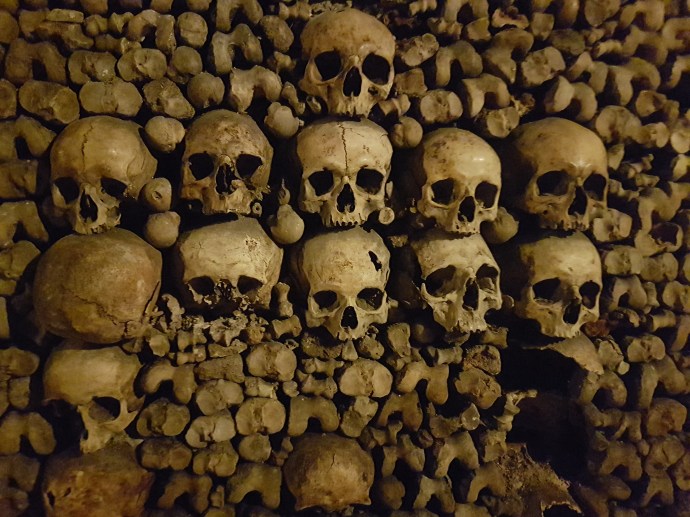
Since their creation, the Catacombs of Paris became a curiosity for more privileged Parisians. Public visits began after its renovation into a proper ossuary and the 1814 – 1815 war.
In the beginning, visits were only granted a few times a year with the permission of an authorized mine inspector. This turned into permission from any mine overseer, but as the number of visitors grew, it returned to its “permission only” rule in 1830. Then, in 1833, they were closed completely as the Church opposed the public being exposed to human remains on display. By 1850, the Catacombs were once again open, but only for four visits a year. Public demand led to the government allowing monthly visits as of 1867. This turned into bi-weekly visits on the first and third Saturday of each month in 1874 and then weekly visits during the 1878, 1889 and 1900 World’s Fair Expositions.


Today, they are open for daily visits, so head over and spend an hour wandering through the 2kms of bone-filled tunnels below the streets of Paris!


Plan your tour
The Catacombs are open daily from 10am-8:30pm (except Mondays and holidays)
Admission is granted in time slots, with the last admission at 7:30pm
Located across the street from Denfert-Rochereau Station
Métro et RER B : Denfert-Rochereau
Bus : 38, 68
Parking : Boulevard Saint-Jacques
Visitor numbers are restricted to 200 at any time. Admission may be delayed for a short time during busy periods. Be prepared to wait. (We did for almost 2 hours).
Distance covered: 1.5 km
Duration of the tour: 45 minutes
No toilet or cloakroom facilities available
For more info, click here


 The Netherlands is known for many things, including wooden clogs, canals, windmills and Heineken beer. So this summer, when we had an afternoon in Amsterdam, we found the perfect spot to spend a few hours sitting near a canal, drinking beer in a windmill brewery! (If only we had wooden clogs…)
 Brouwerij’t IJ


 The tasting area at Brouwerij’t IJ is open daily from 2pm-8pm. For directions click
 Almost every pub in the city sells Altbier and even the more modern ones still wouldn’t be confused with a conventional lager. The best way to enjoy Dusseldorf’s Altbier is at the brewery itself, straight from the wooden barrel. So that’s exactly what we did.


 We were lucky enough to arrive in Dusseldorf during a festival which meant there were Altbier tents from all the local breweries set up with €2 beers! We tried Schlüssel Alt here before heading to Kürzer for our first brewery stop.


 Once again, the Altbier just kept coming until we asked for our bill and the food coming out of the kitchen made us wish we hadn’t just eaten! In both places, we sat near the large barrel casks where a constant flow of Alt was being poured. It was a great way to spend an afternoon with the locals in Dusseldorf!


Recent Comments